
Understanding Forex Trading Charts: A Comprehensive Guide
Forex trading charts are essential tools for traders, providing visual representations of price movements in the currency market. They offer insights that can help traders make informed decisions. In this article, we will explore the types of forex charts, how to read them, and strategies for using them effectively. If you’re keen to explore more about these tools, visit forex trading charts https://forex-exregister.com/.
Types of Forex Trading Charts
There are several types of forex trading charts that traders utilize, including line charts, bar charts, and candlestick charts. Understanding the differences and the contexts in which each type excels is crucial for any trader.
1. Line Charts
Line charts are the most basic form of forex trading charts. They display the closing prices of currency pairs over time, connected by a line. This simplicity makes them easy to read, and they are particularly useful for identifying overall trends. However, line charts do not provide information about the open, high, or low prices within the specified time frame, which can be a limitation for more in-depth analysis.
2. Bar Charts
Bar charts offer more detailed information compared to line charts. Each bar represents a specific time frame (such as 1 minute, 5 minutes, or 1 hour) and displays the open, high, low, and close (OHLC) prices. This allows traders to analyze price movements and volatility. The vertical line of the bar shows the price range, while the horizontal lines indicate the opening and closing prices. Bar charts are particularly useful for identifying price reversals and continuations.
3. Candlestick Charts
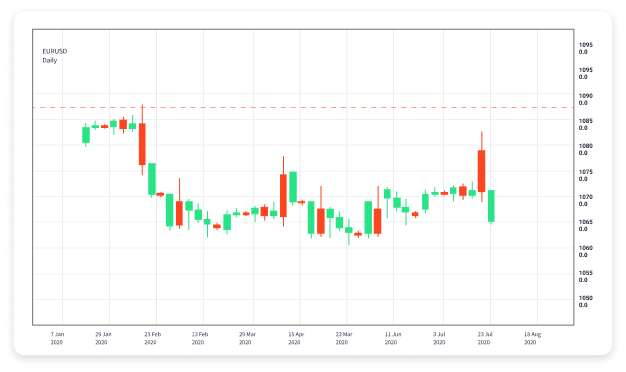
Candlestick charts are similar to bar charts but provide a more visually engaging representation of price movements. Each “candlestick” represents a specific time period and consists of a body and wicks (shadows). The body shows the open and close prices, while the wicks indicate the high and low prices of that period. Candlestick patterns can convey market sentiment and are widely used in technical analysis. They are particularly popular because they can reveal potential reversals and trend continuations through various formations, such as dojis, hammers, and engulfing patterns.
Reading Forex Trading Charts
Successfully reading forex trading charts is vital for making informed trading decisions. Traders must analyze price movements, identify trends, and recognize key support and resistance levels. Here are some essential tips for reading forex charts:
Identifying Trends
Trends are the foundation of trading strategies. A trader should identify whether the market is in an uptrend, downtrend, or sideways movement. An uptrend is characterized by higher highs and higher lows, while a downtrend features lower highs and lower lows. A sideways trend sees the price moving within a defined range. Traders can use trendlines drawn on the charts to identify these patterns visually.
Support and Resistance Levels
Support levels are price points where a currency pair tends to stop falling and may bounce back, whereas resistance levels are where the price tends to stop rising and can pull back. Recognizing these levels can help traders make entry and exit decisions. When the price breaks through these levels, it can signal a strong move in the direction of the breakout.
Utilizing Forex Trading Charts

Once a trader understands how to read forex trading charts, the next step is to use this knowledge to develop trading strategies. Here are some ways traders can utilize these charts effectively in their trading plans.
Technical Analysis
Technical analysis involves analyzing price movements and historical data to forecast future prices. Traders often use indicators and patterns derived from charts to make trading decisions. Common indicators include moving averages, Relative Strength Index (RSI), and Bollinger Bands, which help assess market momentum and volatility.
Chart Patterns
Traders also look for chart patterns, such as head and shoulders, triangles, and flags, which can indicate potential market reversals or continuations. Learning how to recognize these patterns can significantly improve a trader’s chances of success. Each pattern has its own set of characteristics and implications for price movement.
Combining Fundamental Analysis with Charts
While technical analysis focuses on price actions depicted in charts, combining it with fundamental analysis can enhance trading strategies. Fundamental analysis looks at economic indicators, geopolitical events, and central bank policies that can impact currency values. By integrating both approaches, traders can make more informed decisions.
Common Mistakes to Avoid
New traders often make mistakes when analyzing forex trading charts. Here are some common pitfalls to steer clear of:
1. Overcomplicating Analysis
Some traders tend to overcomplicate their analysis by using too many indicators or tools at once. This can lead to confusion and indecision. It is advisable to keep the analysis straightforward and focus on a few reliable indicators.
2. Ignoring Timeframes
Different trading styles require different timeframes. Day traders might use shorter timeframes, while swing traders might focus on longer-term charts. Ignoring the appropriate timeframe can lead to misinterpretations of market movements.
3. Neglecting Risk Management
Regardless of how expertly a trader reads charts, risk management is crucial. Failing to set stop-loss orders or mismanaging position sizes can seriously affect a trading account. Always have a risk management plan in place.
Conclusion
Forex trading charts are powerful tools for traders looking to navigate the currency markets. By understanding the different types of charts, learning to read them effectively, and implementing sound strategies, traders can increase their chances of success. Remember, practice, and continuous learning are key to improving trading skills. Utilize these tools wisely, and remain disciplined in your approach to trading.